Clarence Thomas blasts Section 230, wants “common-carrier” rules on Twitter
Read Original Source
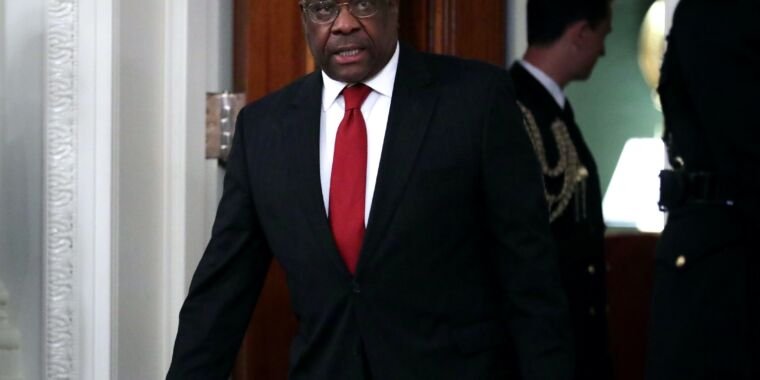
The US Supreme Court today vacated a 2019 appeals-court ruling that said then-President Donald Trump violated the First Amendment by blocking people on Twitter. The high court declared the case “moot” because Trump is no longer president. For legal observers, the ruling itself was less interesting than a 12-page concurring opinion filed by Justice Clarence Thomas, who argued that Twitter and similar companies could face some First Amendment restrictions even though they are not government agencies.
AI Summary
Main Idea: Justice Clarence Thomas used a Supreme Court case about Twitter to argue that online platforms may need stricter rules, including common-carrier-style regulation and limits on Section 230.
Key Points:
- The Supreme Court tossed the Trump Twitter-blocking case as moot because he is no longer president.
- Thomas said private platforms like Twitter may still raise First Amendment issues in limited cases, especially if the government pressures them to censor speech.
- He also criticized Section 230 and suggested Congress could regulate major digital platforms like common carriers, similar to utilities.
- His view drew criticism from lawmakers and legal experts, who said it goes beyond current First Amendment law.
Impact on the People
Negative Impact
If courts or lawmakers adopt Justice Clarence Thomas’s view, Twitter and other platforms could face looser rules on who gets to speak, making online moderation and speech rights less predictable for users and small businesses.
Positive Impact
Stronger common-carrier rules could make large platforms treat users more evenly and limit hidden bias in what people see online.
How did each entity affect people?
Rate how each entity in this article affected the American people.
- Primary:Justice Clarence Thomasperson
- Primary:Twittercompany
Candidate Entities7 candidates · 5 weighted vote min · 70% decision
- Justice Clarence ThomaspersonPrimaryEvaluated
Central figure whose concurring opinion and stated views on Section 230 and digital platform regulation drive the article.
Include 0 (0%)Ignore 0 (0%)5 to threshold - TwittercompanyPrimaryEvaluated
Primary platform at the center of the article’s discussion of moderation power and common-carrier-style regulation.
Include 0 (0%)Ignore 0 (0%)5 to threshold - President Donald TrumppersonMajorAI selected
His Twitter blocking dispute and account removal are the legal context for Thomas’s opinion.
Include 0 (0%)Ignore 0 (0%)5 to threshold - United States Supreme Courtgovernment agency or bodyMajorAI selected
The Court’s decision to vacate the ruling and Thomas’s concurrence frame the story.
Include 0 (0%)Ignore 0 (0%)5 to threshold - Representative Ted LieupersonContextCandidate
Provides a notable public reaction criticizing Thomas’s view.
Include 0 (0%)Ignore 0 (0%)5 to threshold - Stephen VladeckpersonContextCandidate
Named legal scholar offering a reaction to Thomas’s concurrence.
Include 0 (0%)Ignore 0 (0%)5 to threshold - United States Congressgovernment agency or bodyContextCandidate
Referenced as the body that could regulate online platforms and is central to the policy debate.
Include 0 (0%)Ignore 0 (0%)5 to threshold
Comments 0
Comments here are the same thread shown when this article appears in The Pulse.
No comments on this article yet.
Sign in to comment