Alabama asks Supreme Court to allow congressional map found racially discriminatory
Read Original Source
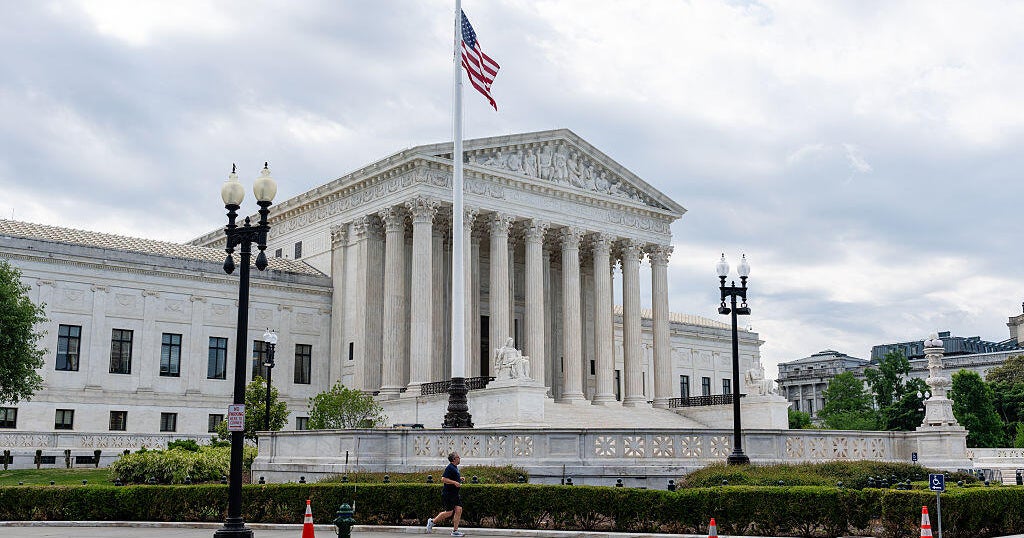
Washington — Alabama Republicans asked the Supreme Court on Wednesday to allow the state to use a congressional map, crafted in 2023, that would give the GOP an edge in the midterm elections, after a district court found that the redistricting plan was racially discriminatory. State officials asked the high court for emergency relief on the heels of the district court's decision that ordered Alabama to use a court-approved map that includes two majority-Black districts for upcoming House contests.
AI Summary
Main Idea: Alabama asked the Supreme Court to let it use its 2023 congressional map, even after a lower court said the plan was racially discriminatory and ordered a map with two majority-Black districts.
Key Points:
- Alabama said it would face harm if it cannot use the map it passed in 2023 for the 2026 House elections.
- A three-judge district court found the 2023 map intentionally discriminated against Black voters.
- The court ordered Alabama to use a different map that gives Black voters more representation.
- The fight is part of a wider push in the South to redraw House maps after a recent Supreme Court voting rights ruling.
Impact on the People
Negative Impact
Alabama’s map fight could weaken fair representation for voters, especially Black communities, and may add confusion and cost before the 2026 House elections.
Positive Impact
A court-approved map could better protect voting rights and give communities a fairer chance to choose their representatives.
How did each entity affect people?
Rate how each entity in this article affected the American people.
- Primary:Alabamastate
Candidate Entities11 candidates · 5 weighted vote min · 70% decision
- AlabamastatePrimaryEvaluated
The state is the main public actor asking the Supreme Court to let it use the contested congressional.
Include 0 (0%)Ignore 0 (0%)5 to threshold - Alabama Republican Partypolitical organizationPrimaryAI selected
Alabama Republicans are driving the push to restore the 2023 congressional map.
Include 0 (0%)Ignore 0 (0%)5 to threshold - Supreme Court of the United Statesgovernment agency or bodyPrimaryAI selected
Central decision-maker in Alabama’s request for emergency relief and the key institution the story revolves around.
Include 0 (0%)Ignore 0 (0%)5 to threshold - Alabama Legislaturegovernment agency or bodyMajorAI selected
The GOP-controlled legislature adopted the 2023 map that is being challenged and defended in the article.
Include 0 (0%)Ignore 0 (0%)5 to threshold - District courtgovernment agency or bodyMajorAI selected
The three-judge court panel issued the ruling finding the map racially discriminatory and ordered a different map used.
Include 0 (0%)Ignore 0 (0%)5 to threshold - Governor Kay IveypersonMajorAI selected
Alabama’s governor took a concrete action by setting a special primary election tied to the expected map changes.
Include 0 (0%)Ignore 0 (0%)5 to threshold - Representative Shomari FigurespersonMajorAI selected
The Black Democratic congressman stands to lose a seat if Alabama reinstates the 2023 map, making him a.
Include 0 (0%)Ignore 0 (0%)5 to threshold
Comments 0
Comments here are the same thread shown when this article appears in The Pulse.
No comments on this article yet.
Sign in to comment